Pier-and-Beam Foundation Repair in Oklahoma City
Sagging floors in an older Oklahoma City house usually trace back to something under the floor that can be fixed: a pier that sank, shims that wore out, or wood that stayed wet too long. Re-shimming is the cheap end of the work. New piers and rotted beams are where the price climbs.
On this page
The short answer
A pier-and-beam house sits on wood beams resting on short columns (piers) with a crawl space underneath. When the floor sags or slopes, the repair is usually some mix of re-leveling the beams, replacing piers that moved, and replacing wood that rotted. National cost guides put the whole job anywhere from under $1,000 for a simple shim adjustment to $25,000 for major structural work.
The good news with pier and beam is access. Someone can crawl under the house and see exactly which pier dropped or which joist is soft, which is harder to do with a slab. The bad news is that wood under a house can rot no matter what the soil is doing, so the fix has to deal with moisture too.
If your floors have started to dip or bounce, the fastest way to know what is under there is to have someone look.
Why this comes up so often in older OKC neighborhoods
Pier and beam was common in older construction, and some Oklahoma City ZIPs are mostly older homes. In our Census ACS 2020-2024 figures, 72% of homes in 73107 were built before 1960, along with 71% in 73103, 69% in 73118 and 61% in 73106. Census data does not record foundation type, so that is a strong hint about your house, not a fact. If you are not sure which kind you have, our pier-and-beam vs. slab guide shows how to tell from the outside.
These neighborhoods also sit on clay. Our soil data, built from the USDA NRCS soil survey, puts 73103 at an LEP of 5.93, near the top of the moderate class. LEP (linear extensibility percent) measures how much soil changes size between wet and dry. A house built in the 1940s has been through a lot of wet and dry seasons on that soil.
How pier-and-beam foundations fail here
A pier-and-beam foundation has more parts than a slab, so it can fail in more places. These are the usual ones.
Settled or tilted piers and pads
Each interior pier sits on a pad or footing in the dirt. When the clay under one pad shrinks in a dry spell, or softens from a leak or poor drainage, that pier drops and the beam above it sags. A pier that leans or cracks does the same thing more slowly.
Worn or missing shims
A shim is a thin spacer between the top of a pier and the beam it holds up. Shims fill the small gap when a pier settles a little. Wood shims compress and rot over time, and some fall out entirely. Angi describes the usual repair as inserting steel shims between the piers and the beams, or between the beams and the floor joists.
Sagging beams and joists
Beams (also called girders) carry the floor joists, the smaller boards the subfloor is nailed to. A beam can sag between piers that are spaced too far apart, and a joist can sag or crack under a heavy load like a bathtub or a piano. Joists that were notched or cut for plumbing and wiring over the years can also lose strength.
Moisture and wood rot
A damp crawl space is the problem the soil does not cause. Researchers at the USDA Forest Products Laboratory describe a long-standing rule that wood kept below about 20% moisture content does not decay, while decay fungi do well at moisture levels above about 25 to 30%. A crawl space with standing water or a slow plumbing leak can keep wood in that range for months. Rot often shows up first in the sill plate (the board that sits on top of the perimeter wall) and in joist ends.
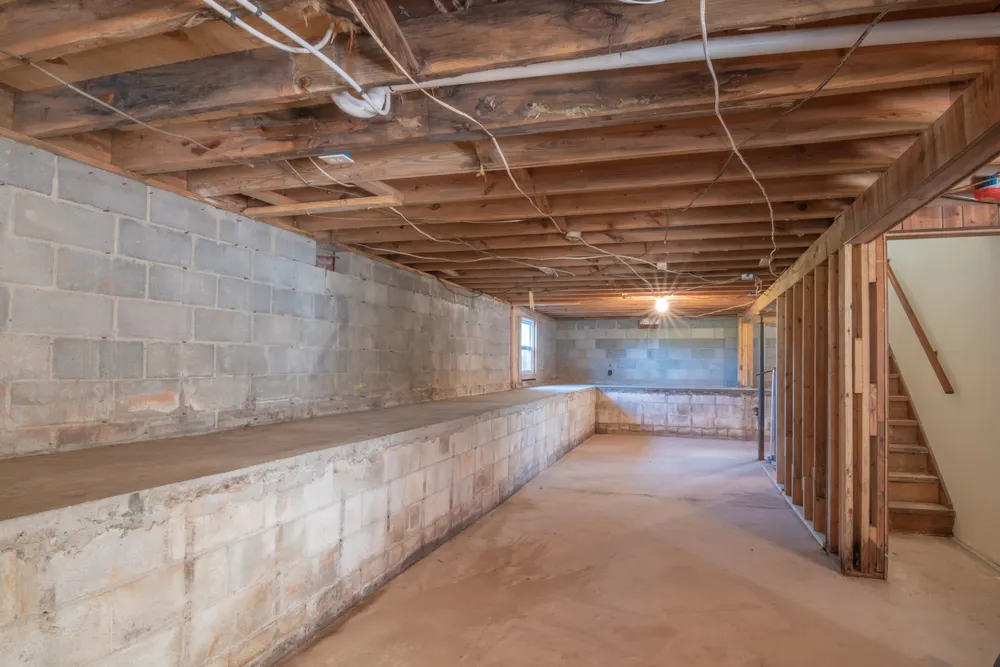
Perimeter beam movement
The outside edge of the house usually rests on a concrete perimeter beam or wall. That edge behaves a lot like a slab: when the clay along it dries and shrinks, it can drop, and you get brick cracks outside along with a floor that slopes toward the outside wall. Dry years make this worse. As of October 20, 2026, the US Drought Monitor had all of Oklahoma County in severe drought (D2) or worse, and 2026 had logged 34 weeks with at least half the county at that level, the most since 2011. More in drought and your foundation.
Signs your pier and beam needs work
Pier-and-beam trouble tends to show up in the floor first and the walls second. Watch for:
- Floors that feel bouncy or springy when you walk across a room
- A floor that slopes enough that a ball or marble rolls toward one spot
- Interior doors that stick, swing open on their own or no longer latch
- Gaps opening between the floor and the baseboards
- Cracks in drywall or plaster running up from the corners of interior doors
- Stair-step cracks in brick near the perimeter, or a musty smell from the crawl space
A soft spot in the middle of a room usually points to an interior pier or a joist. A slope toward an outside wall more often points to the perimeter. That is a tendency, not a diagnosis, and our list of signs of foundation problems covers the rest. If you can see a crack or a gap, a photo is a quick way to get a second opinion before anyone visits.
Repair options and published costs
Here is what each repair is, and when it fits. The prices are published ranges from national cost guides, not quotes.
Re-shimming and re-leveling
The beams are jacked back up and worn shims are replaced, usually with steel. This is the right fix when the piers themselves are solid and only the gaps above them have grown. Angi puts most re-shimming jobs at $1,200 to $2,000, around $1,600 on average. Modernize lists $1,000 to $3,500. If a house needs re-shimming again after a year or so, something underneath is still moving, and paying for another round of shims is poor value.
Adding or replacing piers and pads
Failed piers come out and new ones go in, often on a new concrete pad, and extra piers can be added where beams span too far. Olshan's crawl space price table lists a single pier replacement at about $1,100 to $1,700 and a new pier addition at about $1,100 to $3,000 per pier. Angi's pier-and-beam page puts a single pier replacement at $2,000 to $6,000. The gap between those two sources is wide, so ask exactly what each pier includes.
Replacing beams or sistering joists
A badly rotted or cracked beam is replaced, and a weak joist can be "sistered," which means bolting a new board alongside the old one so they share the load. Sistering costs less than pulling the old joist out. Beam replacement prices vary a lot by source: Angi lists $400 to $1,200 per beam, while HomeGuide lists $1,500 to $4,000 per beam for wood damaged by rot or insects. HomeGuide prices sistering at $150 to $325 per joist on one of its guides and $200 to $1,000 per joist on another, and puts adding a new support beam with posts at about $1,000 to $5,000.
One thing we would not do: leave a hardware-store jack post sitting on a block as the long-term fix. HomeGuide notes adjustable steel jack posts need a solid footing and are a temporary support, not a permanent solution.
Piering the perimeter beam
When the outside edge has dropped, the perimeter beam can be supported with the same steel piers used under slabs. Olshan lists steel push piers at about $990 to $1,350 each. Our foundation piering guide explains the pier types and how contractors decide how many.
Moisture control and vapor barrier
Leveling a floor over a wet crawl space treats the symptom. A vapor barrier is plastic sheeting laid over the crawl space dirt to slow moisture rising into the wood, and HomeGuide puts replacing one at $1,200 to $4,000. Sealing the whole crawl space is covered on our crawl space encapsulation page, and water pooling against the house is covered in French drain installation.
What the whole job tends to cost
| Source | Published range for pier-and-beam repair |
|---|---|
| Angi (pier-and-beam cost page) | $800 to $25,000; average $10,000; most homeowners $6,000 to $14,000 |
| HomeGuide | $2,000 to $15,000 |
| Modernize (updated Sept 2026) | $3,000 to $9,500; about $6,500 typical |
For slab and pier math side by side, see our foundation repair cost guide. Soil matters to the scope too, and you can check yours by ZIP.
What a written estimate should spell out
Two estimates for the same crawl space can look nothing alike. Ask each contractor to put these in writing so you can compare them line by line:
- A sketch of the crawl space showing which piers get new shims and which get replaced.
- Shim material (steel or wood) and the pier and pad type for any new piers.
- Every piece of wood being replaced or sistered, with its size and whether it is treated lumber.
- How much lift they are aiming for, and whether they will take floor elevation readings before and after.
- What they found causing the moisture or settling, and whether fixing it is in the price.
- Who handles door and drywall touch-ups after the floor moves back.
- Whether a permit or engineer's letter is needed, and who pays for it.
- Any warranty, its length, what voids it, and whether it transfers to a buyer.
An estimate that only says "level house" with a single number is hard to hold anyone to. Our guide to choosing a foundation repair company has more questions to ask in person.
When to bring in a structural engineer
Most re-shimming jobs do not need an engineer. We would get one when beams are being replaced, when the perimeter beam is cracked or dropping, when two estimates disagree by thousands, or when you are buying or selling the house. HomeGuide puts a structural engineer's assessment for joist and sagging-floor problems at about $300 to $800, and recommends one when several joists are affected or the floor sags noticeably. An engineer sells you no piers, which is the point. See structural engineer inspections in Oklahoma City for how to find one, and pre-purchase foundation inspections if you are buying an older house.
If you are still deciding whether what you see is a foundation problem at all, the symptom checker sorts the common signs in about a minute.
When you want someone to go under the house and tell you which of these repairs it needs, a local foundation specialist can inspect it and put the scope in writing.
Questions homeowners ask
How much does pier and beam foundation repair cost in Oklahoma City?
National cost guides put most jobs in the low thousands to mid five figures: Angi's pier-and-beam page lists $800 to $25,000 with a $10,000 average, and HomeGuide lists $2,000 to $15,000. Simple re-shimming sits at the low end, and new piers or replaced beams push it up.
What causes sagging floors in an older OKC house?
Usually an interior pier that settled or shims that wore out. Joists and beams weakened by rot are the other common cause. A floor that slopes toward an outside wall more often points to the perimeter beam dropping on dry clay.
Is re-shimming a permanent fix?
It can last a long time when the piers are solid and the crawl space stays dry. If a house needs new shims again within a year or so, something underneath is still moving.
Can a pier-and-beam house be leveled without replacing the piers?
Often, yes. If the piers are sound and only the gaps above them have grown, jacking the beams and replacing the shims may be enough; the contractor who inspects your home should say in writing which piers need more than that.
Do I need a vapor barrier in my crawl space?
If the crawl space is damp or the wood shows rot, moisture control should be part of the repair. HomeGuide puts replacing a vapor barrier at $1,200 to $4,000.
Sources
- Angi: Pier and Beam Foundation Repair Cost (2026)
- HomeGuide: Pier and Beam Foundation Repair Cost (2026)
- HomeGuide: Sagging Floor Repair Cost (2026)
- HomeGuide: Floor Joist Repair Cost (2026)
- HomeGuide: Foundation Repair Cost (2026)
- Modernize: Pier and Beam Foundation Repair Cost Guide (updated Sept 2026)
- Olshan Foundation Repair: Foundation Repair Costs
- Carll and Highley, USDA Forest Products Laboratory: Decay of Wood and Wood-Based Products Above Ground in Buildings (1999)
- US Drought Monitor
- Data: USDA NRCS Soil Survey (SSURGO), US Census ACS 2020-2024, USGS Earthquake Catalog, US Drought Monitor