Chimney and Porch Separation in Oklahoma City
A chimney or front porch that pulls away from an Oklahoma City house usually sits on its own smaller footing or slab, so the clay under it moves on a different schedule than the house. A gap that has stopped growing can be sealed. One that is still widening needs its support fixed first, and a chimney gap also needs the flue checked.
On this page
The short answer
Chimneys, porches, stoops and front steps are usually built as separate pieces that sit against the house. Each has its own footing or slab, often shallower than the foundation under the walls. When the clay under one of them shrinks or washes out, that piece moves and the house does not, and a gap opens at the joint.
A gap is not automatically a crisis. What matters is whether it is still growing and whether cracks run from the joint into the house. For a chimney there is a second question that has nothing to do with the foundation: whether the movement damaged the flue or the flashing at the roof.
If you want a first opinion before anyone visits, a photo of the joint with a tape measure held across it is a good start.
Why these pieces move on their own
Chimneys: a lot of weight on a small pad
A masonry chimney is one of the heaviest parts of a house, and it stands on a single pad of concrete. The International Residential Code (2012 edition) sets the minimum for that pad at 12 inches thick, extending 6 inches past the face of the chimney on all sides. Acculevel, an Indiana repair contractor, describes the chimney's weight as concentrated on a small piece of concrete, and lists a footing not sized for that weight among the causes of a lean.
InterNACHI, the home inspectors' association, names the footing failures inspectors look for, including footings "cast so thin that it breaks" and soil under the footing that has eroded, settled or been affected by expansive clay. Any of those lets the chimney settle or rotate while the house beside it stays put.
Porches and steps: shallow slabs on loose fill
A front porch or stoop is usually a concrete slab poured after the house, often on soil that was dug out and pushed back against the foundation during construction. That fill is looser than the undisturbed ground under the footings, and the slab is thinner than the foundation. It settles as the fill compacts or washes out.
The American Society of Civil Engineers lists "vertical or horizontal separation of concrete driveway, patio, porch, or sidewalks from foundation" among the outdoor signs of shrink-swell soil movement. It can show up as a porch dropping away from the house, or as one pushed up against it after a wet spell.
Water at the joint
The corner where a porch or chimney meets the house is also where roof water tends to land. A downspout that empties onto the stoop soaks one small patch of clay over and over. The ASCE homeowner guide asks for downspouts that discharge at least 3 feet from the foundation, and soil that falls at least 3 inches in the first 5 feet.
The soil varies across the metro. Our ZIP-level analysis of USDA NRCS soil survey data puts 69 to 84% of the land in south and west-central Oklahoma City (73159, 73139, 73119, 73120, 73162) on high shrink-swell clay. Choctaw (73020) and Midwest City (73130) sit mostly on sandy soils with low shrink-swell. As of October 20, 2026, the US Drought Monitor had all of Oklahoma County in severe drought (D2) or worse, and dry clay shrinks. More in drought and your foundation.
You can check how much swelling clay sits under your street.
How to tell an old gap from active movement
These checks cost nothing:
- Measure the gap at the top and bottom of the joint and write down the date. Repeat monthly. A gap that grows between readings is active.
- Hold a 4-foot level against the chimney face or the porch edge. InspectAPedia, an inspection reference site, notes that a gap wider high on the wall than low means the chimney is leaning away, and suggests a plumb line over a taller distance for a more accurate reading.
- Look for torn caulk. InspectAPedia says a line where old sealant has torn away from the house shows movement after it was sealed. It also warns that fresh caulk can hide ongoing movement, which matters if you are buying.
- Follow any crack at the joint. If it continues into the brick or the drywall inside, the house may be moving too. See signs of foundation problems.
- Check the flashing where the chimney meets the roof. Bob Vila's guide to tilting chimneys calls leaks from dislodged flashing a sign that a chimney has settled.
- Check the steps. For new stairs, the 2018 International Residential Code allows the tallest riser in a flight to exceed the shortest by no more than 3/8 inch. A top or bottom step that has dropped well past that is a trip hazard whatever the cause.
If the checks point to movement in the house as well, the symptom checker sorts out which signs matter.
Why a chimney gap is also a fire and water problem
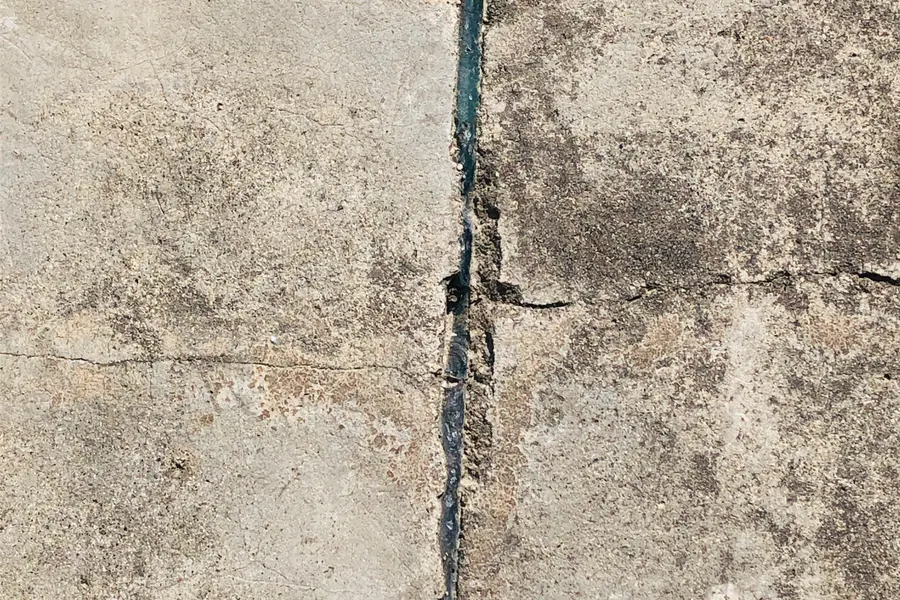
A chimney that moves takes its flue with it. InspectAPedia says "any movement in a masonry chimney risks damage to its interior liner and could be a safety concern." InterNACHI warns that cracks and openings in a damaged chimney "present the risk that sparks or smoke will enter the living space or building cavities." Bob Vila's guide adds that the liner "may even be cracked, leaking combustible gases into the home," and that water and insects get in through the gap at the siding.
Chimney inspections follow NFPA 211, the National Fire Protection Association standard that defines three inspection levels. The Chimney Safety Institute of America (CSIA) procedure for a Level 2 inspection of a masonry chimney recommends one when a property is sold, and after a "weather or seismic event or any operating malfunction likely to have caused damage to the chimney." It requires a video scan of the flue, a report of any cracks or gaps in the liner, and a look at the flashing and at where the chimney joins the house.
Earthquakes count here. The USGS catalog shows 5,387 earthquakes of magnitude 2.5 or more within 120 km of downtown since 2000, and InterNACHI advises having a chimney inspected before using the fireplace after a quake. See earthquakes and foundation damage.
We would not light a fire in a chimney that has pulled away from the house until someone has looked down the flue.
Repair options
Piers under a chimney
When the chimney footing has settled, the usual fix is steel piers beside it with brackets under the footing. Bob Vila's guide describes helical piers turned down to load-bearing soil, then hydraulic jacks slowly raising the chimney toward its original position before the brackets are secured to the piers. Push piers are the other option. How each type works and what each pier costs are on our foundation piering page.
Lifting a porch or stoop
A porch slab still in one piece can usually be raised with slabjacking (pumping a cement slurry under it, also called mudjacking) or polyurethane foam. Methods and prices are on our concrete leveling page. Porch roof posts on footings that have dropped may need small piers instead.
Rebuilding the slab or steps
A porch broken into several pieces, or one that was lifted before and sank again, is a candidate for tearing out and pouring new.
Masonry and flashing work
Once the chimney stops moving, cracked mortar can be repointed, loose brick veneer re-tied to the framing, and the flashing reset. Our foundation crack repair guide covers repointing and re-tying. Liner repair belongs to a chimney sweep.
Sealing the joint, last
The gap is closed with a foam backer rod pushed into the joint and a flexible sealant over it. C.R. Laurence's backer rod guide explains why the rod matters: it keeps sealant from sticking to the back of the joint, so the bead bonds only to the two sides and can stretch. It calls for a bead at least twice as wide as it is deep. Do this only after the movement has stopped. A sealant joint flexes a little. It does not hold a porch to a house.
Drainage
Move or extend the downspout past the porch, and regrade so water runs away from the joint. Without it, a lifted porch or a piered chimney sits next to the same wet clay that moved it. For water that collects in a low corner, see French drain installation.
Published costs
These are ranges from national cost guides, not quotes.
| Work | Published range | Source |
|---|---|---|
| Leaning chimney repair | $1,500 to $3,500 | Fixr |
| Chimney foundation repair | $1,500 to $3,500 | Fixr; Bob Vila |
| Chimney rebuild | $500 to $4,000 | Fixr; Bob Vila |
| Chimney flashing repair | $200 to $300 | Fixr |
| Chimney flashing replacement | $300 to $800 | Fixr |
| Chimney liner replacement | $1,200 to $4,600 | Fixr; Bob Vila |
| Level 2 chimney inspection | $100 to $500 | Bob Vila |
| Leveling a porch | $500 to $1,500 | Fixr |
| Concrete step repair, national average | $768 to $2,785 | Thumbtack |
| Replacing concrete steps | About $300 per step | Thumbtack |
Read the chimney foundation line with care. Its top figure is about what one helical pier costs at the published prices on our piering page, so a chimney that needs piers can land above it. Ask how many piers the plan uses and why. For whole-house numbers, see foundation repair cost in Oklahoma City.
Who to call first
A chimney needs two people who look at different things. A chimney sweep with CSIA's Certified Chimney Sweep credential can do the Level 2 inspection and tell you whether the flue is safe; CSIA runs a locator on its site. A foundation specialist looks at the footing and tells you whether the chimney is still moving. If you use the fireplace, call the sweep first. If the two disagree about what moved, an independent structural engineer can settle it.
For a porch or steps, start with the foundation specialist, who can check the slab and the house in one visit.
What the written estimate should spell out
- What moved, with the gap and tilt measurements taken that day.
- The cause, and the drainage fix that goes with the repair.
- For piers: the count, a drawing of where they go, and the depth and force or torque recorded at each one.
- How much lift is expected, and whether the gap should close.
- Who handles the flashing and masonry, and whether the flue gets scanned again after a chimney is lifted.
- For steps, the riser heights after the work.
- Joint sealing with backer rod, done after the lift.
- Warranty terms in writing, including what counts as failure.
More questions are in choosing a foundation repair company. A local foundation specialist can measure the gap, check the house beside it, and put the cause and the fix in writing.
Questions homeowners ask
Is a chimney pulling away from the house dangerous?
It can be. InterNACHI lists tilting or separation from the building as a chimney defect, and InspectAPedia says any movement in a masonry chimney risks damage to its liner. Have a Level 2 chimney inspection before using the fireplace.
How much does it cost to fix a chimney pulling away from the house?
Fixr lists leaning chimney repair and chimney foundation repair at $1,500 to $3,500 each. A job that needs several piers, a new liner or a rebuild can cost more.
Can I just caulk the gap between my porch and the house?
Only once the porch has stopped moving. Then backer rod and a flexible sealant keep water out of the joint. Caulk on a gap that is still growing will tear, and it can hide the movement from the next inspector.
Why are my front steps pulling away from the house?
Steps and stoops usually sit on a shallow slab over fill soil next to the foundation, so they settle or swell on their own. A downspout emptying beside the steps can speed that up.
Should I call a chimney sweep or a foundation company first?
If you use the fireplace, start with a CSIA-certified chimney sweep, who can check the flue. The foundation specialist then deals with the footing that moved.
Sources
- International Residential Code 2012, Chapter 10, R1001.2 and R1003.2 (reproduced by Rumford)
- InterNACHI: Chimney Inspection: Preventing Collapse
- InspectAPedia: Chimney leaning or separation diagnosis
- InspectAPedia: Chimney movement, ongoing vs static
- Chimney Safety Institute of America: SOP, Level 2 Inspection of a Masonry Chimney (rev. 2019)
- Chimney Safety Institute of America: Certified Chimney Sweep credential and locator
- Bob Vila: Tilting chimney (updated Sep 2020)
- Acculevel: A leaning chimney could be trouble (May 2019)
- ASCE Geo-Institute, Living With Shrink/Swell Soils: A Homeowners' Guide
- Town of Timnath: 2018 Residential Stair Guide (IRC R311.7.5.1)
- C.R. Laurence: Backer rod basics
- Fixr: How much does it cost to repair a chimney? (updated Jan 2025)
- Bob Vila: Chimney repair cost (updated Oct 2023)
- Fixr: How much does it cost to repair a porch? (updated Feb 2024)
- Thumbtack: How much do concrete step repairs cost? (updated Apr 2026)
- Data: USDA NRCS Soil Survey (SSURGO), US Census ACS 2020-2024, USGS Earthquake Catalog, US Drought Monitor